


Small and medium-sized enterprises (SMEs) are the backbone of most economies, driving employment, innovation, and local growth. Yet, when it comes to banking, SMEs often feel underserved. Traditional banking systems struggle to balance high service demands with the relatively lower profit margins SME customers bring. This is where intelligent digital solutions – especially those built on Artificial Intelligence (AI), Domain-Driven Design (DDD), and Retrieval-Augmented Generation (RAG) – are starting to redefine what’s possible.
At FIX Partner, we believe the next generation of SME banking assistants will not just automate tasks, but also act as an AI Financial Advisor – understanding business contexts, providing relevant financial advice, and improving both customer satisfaction and bank efficiency. Let’s unpack how these technologies come together to build smarter banking experiences.
Understanding the SME Banking Gap
SME banking has long been a challenging space. SMEs typically require personalized support – from loan applications to cash flow management – but rarely generate enough revenue per account to justify dedicated relationship managers. Many banks have responded by digitizing their processes, yet most digital banking apps remain one-size-fits-all solutions.
Here are some key issues we’ve observed:
- Fragmented service journeys: SMEs interact with multiple departments, such as lending, treasury, and insurance, often repeating the same data multiple times.
- Generic advice: Financial insights are broad and lack the contextual understanding of each business’s reality.
- Limited proactive support: Banks tend to react to requests rather than anticipate needs.
This gap has created a clear opportunity for innovation – a smarter, AI-powered SME banking assistant that bridges human empathy and data-driven precision.
The Rise of the SME Banking Assistant
An SME banking assistant is more than a chatbot. It’s an intelligent digital companion designed to help small business owners make better financial decisions. Whether integrated into mobile banking apps or offered as a web platform, this assistant can handle tasks like:
- Answering financial queries in natural language
- Recommending suitable financial products
- Analyzing cash flow trends and offering early warnings
- Simplifying compliance and document submission
But the real transformation happens when this assistant understands the “why” behind SME behavior. To achieve that, the assistant’s architecture must combine human-centered design with robust AI foundations – and that’s where DDD and RAG come into play.
DDD & RAG: Building Smart, Adaptive Foundations for SME Banking
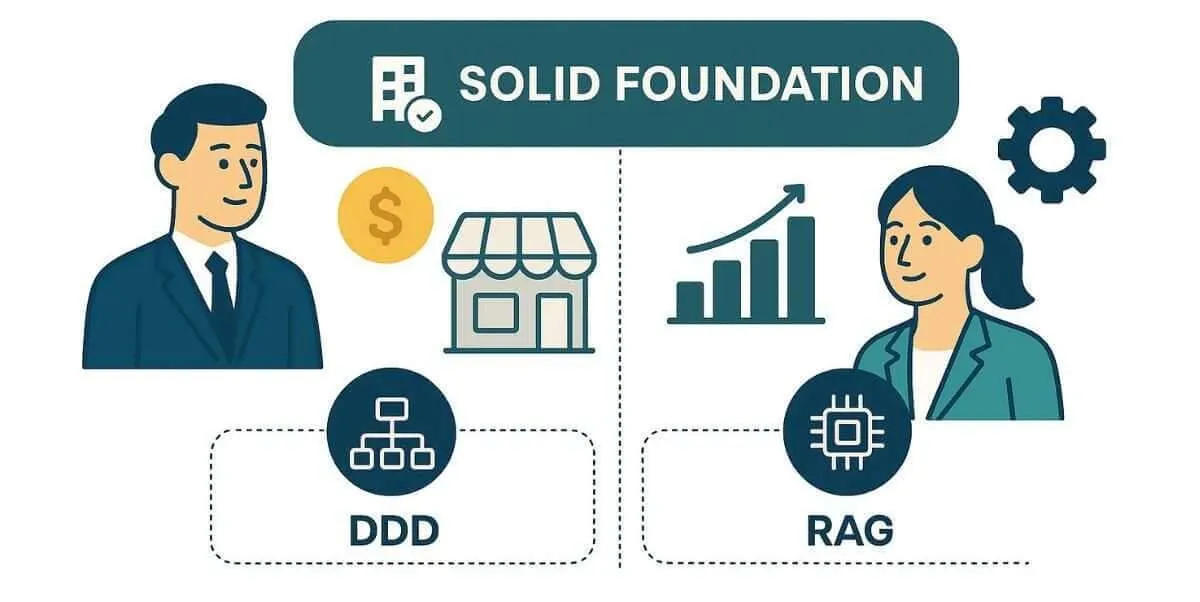
Behind every effective SME banking assistant lies a solid foundation – one that understands how businesses truly operate and evolves with changing market realities. That foundation is built on two complementary approaches: Domain-Driven Design (DDD) and Retrieval-Augmented Generation (RAG).
Domain-Driven Design (DDD): Building the Right Foundation
Strong digital banking systems start with one essential principle – clarity of purpose. Domain-Driven Design (DDD) ensures that technology reflects how real businesses work, not just how software is coded. It focuses on aligning systems with genuine business activities, so every digital solution serves a practical, understandable goal.
In SME banking, DDD acts as a translator between banking professionals and developers. Instead of designing generic systems, it encourages both sides to define “domains” – each representing a key business area. For instance, the Loan Application domain covers how SMEs apply for and repay financing, along with risk and approval rules. The Cash Flow Advisory domain captures income and expense patterns, enabling banks to provide better financial insights. The Compliance and KYC domain ensures smooth verification processes while keeping regulatory requirements transparent.
By structuring around these domains, the SME banking assistant becomes flexible, adaptive, and easier to evolve. Each component can improve independently while still serving the larger banking ecosystem.
More importantly, DDD ensures that AI integration supports real banking goals – delivering insights that are relevant, explainable, and business-driven. The result is not just smarter automation, but a system that genuinely understands and empowers both banks and SMEs.
Retrieval-Augmented Generation (RAG): Keeping AI Knowledge Fresh
Artificial Intelligence delivers real value only when its knowledge stays current. Retrieval-Augmented Generation (RAG) gives AI this edge by allowing it to fetch the most relevant and up-to-date information before generating a response. Instead of relying solely on pre-trained data that quickly becomes outdated, RAG dynamically retrieves facts from trusted, real-world sources every time it answers a question.
For example, an SME banking assistant can use RAG to access the latest financial programs supporting renewable energy investments. When a business owner asks, “What funding options are available for solar projects in 2025?”, the assistant can retrieve verified information such as the USDA’s Rural Energy for America Program (REAP), which offers guaranteed loans and grants for small businesses adopting renewable energy systems.
Similarly, when an SME compares international transfer fees, RAG ensures the assistant references real-time rate data rather than outdated averages – offering advice grounded in live market insights.
By continually linking reasoning with verified data, RAG bridges the gap between static AI models and a fast-changing financial world. Combined with Domain-Driven Design (DDD), it creates an ecosystem where insights are accurate, explainable, and always aligned with real business needs.
Practical Example: From Query to Action
Let’s walk through a typical use case.
- User Query: A small retail shop owner types, “Can I get a loan to expand inventory before the holiday season?”
- Retrieval (RAG): The assistant searches the bank’s internal database and current market programs for SME short-term credit options.
- Domain Mapping (DDD): It identifies this as a “Loan Application” domain and triggers the relevant business rules – credit eligibility, risk assessment, repayment terms.
- AI Reasoning: Based on historical data and the customer’s transaction patterns, the assistant predicts repayment likelihood and recommends a suitable product.
- Personalized Response: The assistant replies: “You may qualify for a 6-month working capital loan of up to $50,000 at 5.2% interest. Would you like me to start the application?”
Here, AI doesn’t just automate – it advises, assists, and acts, mirroring the best traits of a human relationship manager but at a digital scale.
Benefits for Banks and SMEs
For SMEs:
- Simplified experiences: Instant responses, intuitive interfaces, and proactive insights.
- Better decisions: Data-driven financial guidance that aligns with real business goals.
- Time savings: Automated tasks like document verification or compliance updates.
For banks:
- Operational efficiency: Reduced manual workloads and faster loan processing.
- Customer retention: More relevant engagement and higher satisfaction.
- Data intelligence: Deeper insights into SME behaviors and market trends.
At FIX Partner, we view this as a win-win transformation – technology not replacing relationships, but enhancing human connection through smarter automation.
Implementation Insights from FIX Partner
Building an intelligent SME banking assistant takes more than advanced AI models. It requires a thoughtful combination of strategy, structure, and collaboration to ensure technology truly serves business goals. At FIX Partner, we’ve learned that success comes from balancing innovation with practicality – and that begins with four essential steps.
- Domain Discovery: Every project starts by understanding the business. Our teams work closely with bankers, SME clients, and analysts to identify key business domains such as lending, cash flow management, and compliance. This step ensures that the system architecture mirrors real banking operations, not abstract technical models.
- Data Governance: Clean, reliable data is the foundation of every intelligent system. We establish clear data governance practices to guarantee that all information feeding the AI is accurate, well-structured, and compliant with regulations. This allows insights and recommendations to be both trustworthy and actionable.
- Human–AI Collaboration: AI should support, not replace, human expertise. We design the assistant to recognize when a query requires human judgment and seamlessly connect users with relationship managers. This collaboration strengthens trust and preserves the human touch in digital interactions.
- Continuous Learning: Through Retrieval-Augmented Generation (RAG) pipelines, the assistant continuously updates its knowledge base – learning from new data, regulations, and customer interactions. This keeps its advice relevant, contextual, and up-to-date.
At FIX Partner, our approach goes beyond technology deployment. We align every solution with strategic business intent and focus on what we call “Success Fulfillment” – achieving measurable outcomes while ensuring both banks and SMEs experience lasting satisfaction and real progress.
The Human Touch in a Digital World
Technology may power the next generation of banking, but the essence of trust still lies in human connection. For small and medium enterprises (SMEs), banking isn’t just about transactions – it’s about relationships, reassurance, and understanding. A truly effective SME banking assistant must capture that human touch, blending intelligence with empathy.
At its best, AI doesn’t replace people; it amplifies their ability to serve. By designing systems that communicate naturally – asking clarifying questions, explaining options clearly, and responding with emotional intelligence – banks can make digital interactions feel more like meaningful conversations. This ensures that even through a screen, SME clients still feel heard, supported, and valued.
A human-centered design philosophy transforms automation into assistance. It allows banks to be present for their clients 24/7, across borders, without losing warmth or authenticity.
Looking Ahead: The Future of SME Banking
As AI, DDD, and RAG technologies mature, we can expect SME banking assistants to become indispensable. They will:
- Predict financial challenges before they occur.
- Automate complex reporting and compliance tasks.
- Offer real-time, personalized financial coaching.
- Integrate seamlessly with accounting software and e-commerce platforms.
The banks that embrace this transformation early will not only improve customer loyalty but also redefine what trust and intelligence mean in digital finance.
At FIX Partner, we see this evolution as more than a technical project – it’s a journey toward fulfillment, where innovation meets purpose and success is shared between banks and the businesses they empower.
Contact us to explore how we can help you design and implement a smarter SME banking assistant that transforms service experiences and drives lasting success.

