


Mastering Multi-Cloud Management
Businesses are no longer confined to a single cloud provider. The push for flexibility, resilience, and efficiency has given rise to multi-cloud management, a strategy where organizations use services from multiple cloud platforms at once. For many leaders, especially those outside of IT, the term may sound highly technical. Yet the reality is simpler: it’s about giving your business more choices, better performance, and greater control over how digital resources are used.
This article will break down what multi-cloud management means, why it matters, and how your business can approach it with clarity. Let FIX Partner explore the practical benefits, hidden challenges, and strategies to overcome them. Each section is crafted to use plain language, so you can easily see how cloud technology connects to your organization’s growth.
Why Multi-Cloud Management Matters
At its core, multi-cloud management is about creating resilience for your business. Imagine relying on just one delivery truck for all your goods—if it breaks down, everything comes to a stop. Now imagine spreading those goods across several trucks. Even if one fails, the others keep moving. That’s the advantage of working with multiple cloud providers.
- Choice and flexibility: Instead of being tied to one vendor, you can select the services that best fit your business needs. One provider may excel at storage, another at analytics—you’re free to combine their strengths.
- Business continuity: Downtime is costly. With a multi-cloud setup, if one system falters, another can seamlessly take over, keeping your operations running.
- Cost efficiency: Competitive pricing across providers ensures you’re never locked into one company’s terms.
For business leaders, multi-cloud management means stability, smarter options, and stronger control over digital growth.
Key Components of Multi-Cloud Management
Adopting more than one cloud provider can give your business flexibility and resilience, but without the right structure, it can quickly turn complex. That’s where multi-cloud management becomes essential. To make it effective, three key components need to be in place: integration, visibility, and security.
1. Integration of Multiple Platforms
When your business uses several cloud providers, each may have its own way of handling data and applications. Without integration, these systems operate in silos, making collaboration difficult. Multi-cloud management ensures platforms can “talk” to each other, allowing data to flow seamlessly. This integration keeps operations functional rather than fragmented, so employees don’t waste time switching between disconnected tools.
2. Centralized Visibility
Working with multiple providers can make it hard to see the bigger picture. Where is your data stored? How much are you spending? Are policies being followed? Centralized visibility addresses these questions by consolidating information into one view. Dashboards and monitoring tools give your business real-time insights into performance, usage, and costs. This clarity allows leaders to make informed decisions without needing to dive into technical details.
3. Security and Compliance
Every provider has its own rules and security measures, which can be overwhelming. Multi-cloud management creates a unified layer of control, so you can apply consistent policies across all platforms. This reduces the risk of gaps in protection, ensuring your business remains aligned with industry regulations. Strong governance in this area not only protects data but also builds trust with customers and partners.
Together, these components make multi-cloud management less of a technical challenge and more of a business enabler. They ensure that complexity turns into clarity, giving your organization the control it needs to grow with confidence.
Benefits and Common Challenges for Your Business
Benefits
Adopting a multi-cloud management strategy is more than just a technical decision—it’s a way to build a stronger, more adaptable business. By spreading workloads across multiple providers, you gain resilience, cost control, and broader reach, all of which directly support long-term growth.
1. Improved Resilience
Downtime is one of the most damaging risks a business can face. When everything depends on a single provider, an outage can halt operations instantly. With multi-cloud management, workloads are distributed, so if one platform experiences issues, another can step in. This not only protects daily operations but also strengthens customer trust, showing that your business can deliver consistently.
2. Cost Optimization
Cloud pricing can be difficult to navigate, with different models and hidden charges. Multi-cloud management gives you the flexibility to choose where workloads run, balancing performance with cost efficiency. By comparing and leveraging favorable rates, your business avoids vendor lock-in while ensuring that spending aligns with actual needs.
3. Performance and Reach
Each cloud provider has unique strengths—whether it’s faster data processing, better storage, or stronger regional presence. Multi-cloud management allows you to combine these advantages, delivering improved performance for your users. It also enables expansion into new markets, where a single provider might not have the infrastructure to support your growth.
In short, multi-cloud management is not just about technology—it’s about creating a business environment that is resilient, cost-effective, and ready to expand. These benefits give leaders confidence to scale without unnecessary risks.
Common Challenges
While multi-cloud management offers clear advantages, it is not without its difficulties. Understanding these challenges is the first step to addressing them effectively.
1. Complexity of Operations
Every cloud provider has its own systems, tools, and pricing models. Managing several at once can quickly become overwhelming without a structured approach. A lack of coordination may lead to inefficiency, duplicated efforts, and missed opportunities. Businesses need clear strategies to streamline operations across providers.
2. Skills Gap
Many leaders assume IT teams can adapt to new environments with ease. In reality, multi-cloud requires specialized knowledge. Teams must learn how to integrate platforms, manage security, and monitor costs across multiple systems. Without proper training or expert guidance, businesses risk delays, errors, and operational bottlenecks. Investing in skills is essential to make the strategy work.
3. Hidden Costs
While multi-cloud can reduce dependency and optimize spending, it can also introduce unexpected expenses. Data transfer fees, underused services, or overlapping tools can erode savings if not monitored. Proactive cost management is necessary to prevent budgets from spiraling.
By recognizing these challenges early, leaders can build strategies that reduce complexity, close skill gaps, and manage costs effectively—turning obstacles into opportunities for smarter growth.
Practical Strategies for Success with FIX Partner
At FIX Partner, we understand that adopting a multi-cloud strategy can feel overwhelming, especially if you’re not deeply involved in technology. That’s why we focus on turning complexity into clarity. Our role is to guide your business step by step, ensuring that your cloud investments support growth, resilience, and efficiency.
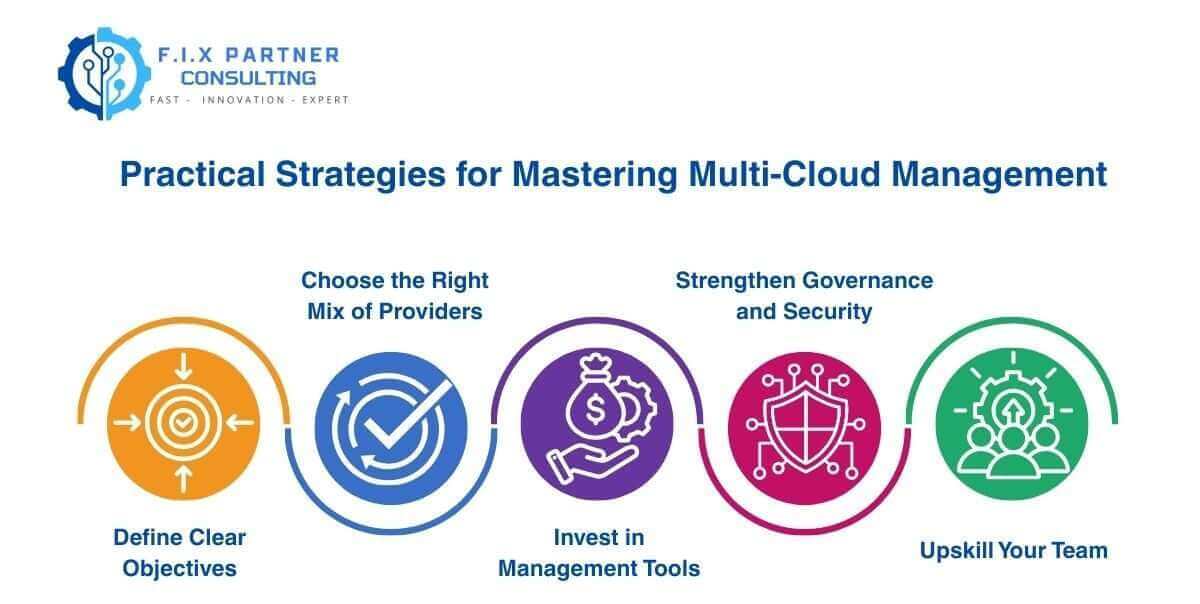
1. Define Clear Objectives
We believe success starts with asking the right questions. Do you want to reduce costs, improve reliability, or accelerate market entry? By defining your “why,” we help you avoid the trap of adopting multiple platforms without a clear direction.
2. Choose the Right Mix of Providers
Every cloud provider has different strengths. Some are excellent in analytics, others in scalability or global reach. We work closely with you to identify the right combination that fits your business priorities, ensuring you don’t waste resources on mismatched services.
3. Invest in Management Tools
Managing multiple providers manually is inefficient and risky. That’s why we bring in centralized dashboards, automation, and analytics tools. These solutions give you a clear overview of performance and costs, reducing errors and saving valuable time.
4. Strengthen Governance and Security
Your business needs consistency across all platforms. We establish policies that protect data, maintain compliance, and minimize risks. This unified approach creates confidence, both inside your team and with your customers.
5. Upskill Your Team
Technology only delivers value when people understand how to use it. We provide training and support to enable your workforce to confidently manage cloud environments, turning knowledge into a competitive advantage.
At FIX Partner, our strategies are designed to make multi-cloud management not just a technical project, but a business advantage. We help you build resilience, control costs, and scale with confidence.
Real-World Applications
Multi-cloud management isn’t just a concept—it’s an approach embraced by real companies to solve real challenges.
Example 1: Retail Business – Airbnb
Consider Airbnb, which uses both AWS and Google Cloud Platform. AWS supports its core infrastructure, while GCP handles big data processing and machine-learning applications. This blend boosts data analysis, improves fraud detection, and keeps infrastructure costs in check
Example 2: Financial Services – HSBC
Global banking leader HSBC leverages AWS, Google Cloud, and Microsoft Azure. By strategically spreading workloads across these platforms, HSBC enhances regulatory compliance across different regions, tightens risk management, and gains the flexibility needed to launch services faster
Example 3: Startups – Stake
In the fintech world, Stake, an online trading platform, deploys CockroachDB across AWS and GCP in multiple regions. This enables precise control over data location, seamless scale-up, and high availability—essential for a company aiming for global reach and reliability.
These examples show how businesses of all sizes and sectors—from hospitality to finance to fintech—use multi-cloud strategies to transform operations, improve user experiences, and boost resilience.
The Human Side of Multi-Cloud Management
It’s easy to view cloud management as purely technical, but it is also about people. The decisions made affect how employees work, how customers experience services, and how leaders make strategic choices. Communication, alignment, and trust are just as important as tools and platforms.
For non-IT leaders, the key is to see multi-cloud not as an IT experiment but as a business enabler. Every decision—whether cost reduction, service resilience, or customer satisfaction—links back to your organization’s goals.
Conclusion
Multi-cloud management is about more than juggling providers. It is about empowering your business with choice, stability, and competitive advantage. By breaking down the complexity into clear strategies—objectives, provider mix, tools, governance, and people—you can transform what seems like a technical challenge into a business opportunity.
The companies that thrive in the digital age will not be those who simply adopt the cloud, but those who master multi-cloud management with clarity, purpose, and confidence.
Contact FIX Partner to explore how we can help your business simplify multi-cloud management, reduce risks, and unlock long-term growth with the right strategy.

